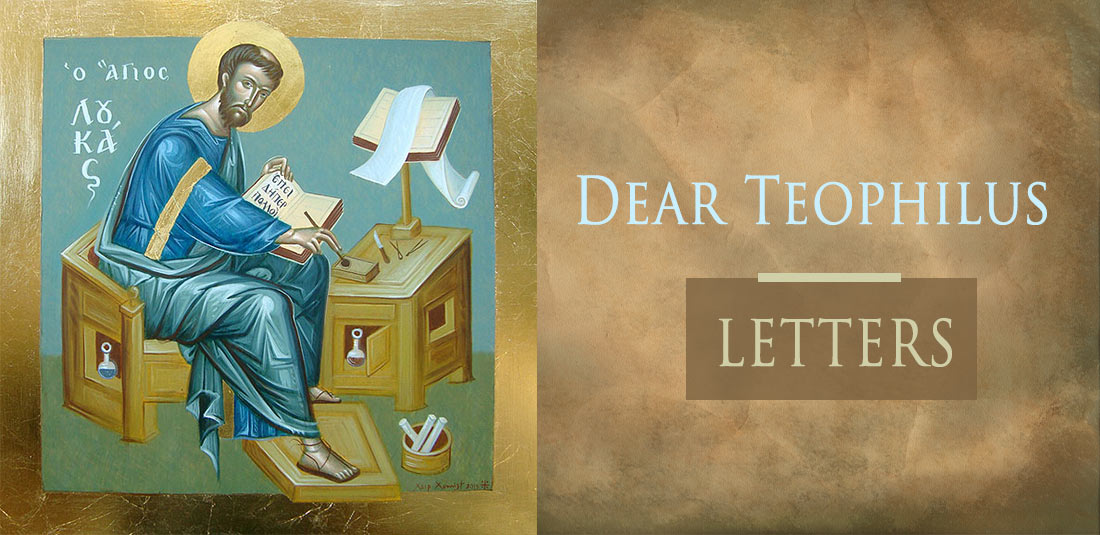
Dear Theophilus , (Letter 1. )
It was very nice to hear from you. I have been very busy but now I have the chance to write to you again. From your questions I can see that this time you would like us to go a little deeper.
I would like to briefly describe what is probably the popular idea of what Christianity is and what you probably have in mind. The world and man were created by God but something went terribly wrong which we refer to as the Fall and the responsibility for this Fall rests with man who now suffers, is attacked by disease, illness and eventual death. Even the possibility of asking for forgiveness was denied them as one of the Fathers of the Church, St. Athanasius pointed out. Adam did express regret but it seems that God would have none of it. And so, humanity lived in squalor and disease and death awaiting the fulfilment of prophecies which spoke of the redemption of humanity. With the coming of Christ, the punishment that was due humanity was taken by Christ and through his death and suffering, God was appeased and now the road for us has been opened either go to heaven or hell, depending on our moral behavior. There are already indications of flaws in this scheme. Just one example will suffice to point this out. In one of the prayers of the Church, we pray to be forgiven for sins committed consciously and those committed without our personal awareness. How fair is this that our future eternal fate depends on transgressions that we may have committed without even being aware of our sinning? There are many other examples that can be presented, and the atheists have done a good job doing this.
This is in a nutshell what many believe is the essence of Christianity this long story which culminates in our chance to go to heaven. This has been widely criticized because it leaves many unanswered questions. What is the point of the universe, a universe that we are starting to realize is unimaginably huge. What about the rest of creation? Everything is centered on humanity, omitting to give any importance to animals, to everything else that there is. The question looms large – what is the point of creation if it is merely a backdrop to humanity’s moral struggle. In fact, what we will see is that the story of Christianity is much richer and much more inclusive than it is popularly portrayed.
The behavior of Churches over time, to say the least, has not been totally exemplary leading to political abuse, support for wars and a neglect for humanity, totally incompatible with what the teachings of the Christian faith say. Is it any wonder that Church membership has waned?
One of the weaknesses that comes up when we explore Christianity is that it fails to take into consideration the wider picture of the totality of what is spoken of in the whole of the Bible, not just excerpts here and there. When we do that, we come to see a more complete picture and we see the essential unity of the whole of the Bible which presents before us a comprehensive picture of creation and its goal. There are intimations of this in the stories that we tell and this story, told by the Bible, which is the basis of all of our epic stories, is something that all humanity resonates with. The truncated picture of Christianity is widespread in our culture and it is easily caricatured and disbelieved. It is not easy to see the deeper side of Christianity and it will take effort but this effort will be rewarded with a more solid faith. Yes, the Bible is not always easy to understand, and it takes much effort but there is also another extremely important factor: what is our view of the Bible, what is our view on revelation, can God communicate with people and our answers to these questions will color all of our explorations. In the words of John Updike:
Let us not mock God with metaphor,
Analogy, sidestepping, transcendence;
Making of the event a parable, a sign painted in the
Faded credulity of earlier ages. (Seven Stanzas at Easter)
I think that Updike has hit the nail on the head. Many of us write off the Bible just as if it were simply imaginative and poetic writing devoid of any connection with the reality that we think we see out there. We tend to interpret statements that should be taken as true in an allegorical or symbolic meaning only. The Bible is not factually true – as if this is the only valid way of getting to the truth – forgetting that reality, creation is so rich that it cannot be bounded by mere words or mere logic. By the way, let me remind you that logic never adds to our knowledge – it is simply a play with words that we use to try to grasp some aspect of reality. Wittgenstein, one of the pree-eminent philosophers of the twentieth century wrote in Tractacus Logico-Philosophicus (loosely modeled on Genesis) – What we cannot speak about, we must pass over in silence. Silence attests to our limitation, to our mortality and we try to fend it off with all kinds of words, forgetting that sometimes we need to be silent.
Strange as it may seem, it should be pointed out that Christianity did not have its origins as some new religion, but it represented a new way of being human, a new way of seeing creation, in fact, and this is extremely important, a new way of seeing who God is. It really didn’t teach something new – it did something new. It is interesting that when one reads the writings of the desert fathers, how little is really said about sins. The focus is on forgiveness and on love, on being charitable. Now, they were well aware of the ubiquitous presence of sin but that was not the main focus of their attention. What was of paramount importance for them was the heart-rending charity which they tried to live out. Interestingly, and ironically, sin has taken center stage for many Christians and dominates their faith and this flies in the face of what Christianity is mainly about. This does not mean that sins do not exist or that they are not important. They are very important but the overemphasis on sins should not block out what are the main important issues for Christianity.
The other charge that has been raised is a searing question – what has changed? The world continues on its downward spiral of violence, war and hatred. So how has Christianity changed anything? Yes, there are pockets of attempts at making a better world but these are really minor when looked at in the perspective of the evil that rules in the world. This point is often raised by those who follow Judaism. If Jesus is the Messiah, where is the Messianic Age? This is an understandable question because, despite all the hints that Jesus gave his disciples, even they still could not make sense of the crucifixion, which they saw as an abysmal failure and a complete disaster. These were people very close to Jesus and if anyone should have seen the wider picture, it would have seemed that it would be they. And yet, they too were dejected, and they too felt the mission of Jesus had failed and it was all over. And there are many within today’s society who would concur with this judgement.
There is also the question of whether God exists or not. But the question of atheism is one with little rational support. To suppose that all this exists out of some shear inexplicable event is hard to accept. But there is a corollary to the question of whether God exists or not. What kind of god? Personal or non-personal? Caring or non-caring? In light of the utter vastness of the cosmos, the idea of a god who cares for the dust that is humans stretches incredulity to its limits. And how are we to answer these questions? Where do we turn for information on these important points?
Some, probably many, have turned to science in hopes of receiving some answers to that overarching question of why. Science has become such an important force within our society that it has quickly taken on the role of a litmus test for what is true and what is not. Claims are put forward that science has disproved the need for God in exploring and explaining the cosmos. Many claim that everything arose through two factors – chance and an immeasurable amount of time. We find that as we search for the meaning of existence and the universe, it seems, in the words of a Nobel prize winner in physics, that the more we search the more we come to the conclusion that it is all meaningless. Meaninglessness grows in concert with our expanding knowledge of the cosmos.
Sincerely,
Bar-Abbas