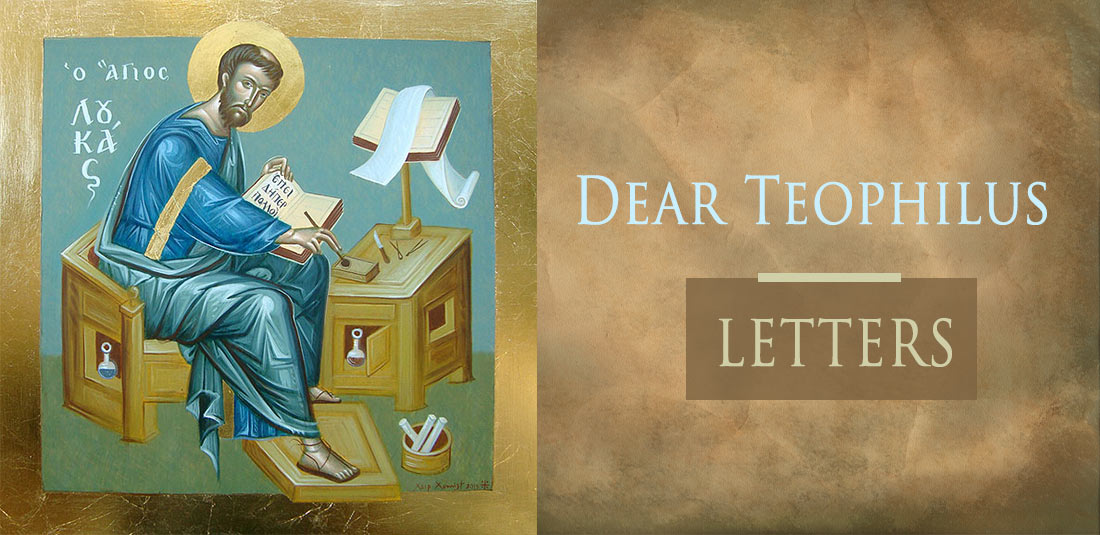
Dear Theophilus , (Letter 2. )
I think that the best way we can carry on our conversation is by going to the beginning of this over-arching big story that we call the Bible.
Everybody is familiar with the story of Adam and Eve and this has become an explanation for the dire predicament that humanity finds itself in. Adam transgressed a command from God and now the price has to be paid for this transgression through suffering and death. Many have rebelled against this simplistic explanation of the state in which the world finds itself and many cannot accept the usual explanation. And understandably so.
Now, everybody is well aware of the fact that something is terribly wrong with the world as it is but what other explanation can we give aside from the usual one? Seeing the wrongness of the world, humanity lapses into a judicial explanation. Deeds are judged, rewards are meted out. It is interesting how common this thread is in all religions – it almost seems the default position of trying to explain the palpable fallenness of creation.
In spite of this deep challenge presented by a corrupted creation, Christianity has always adhered to the position that creation is good, mainly because the author of creation – God – is good. But what is important is that creation is good not in itself but in the fact that it speaks of something beyond it. Creation is an expression of love but it does not have an independent existence in that it itself is not God.
One of the things that the early chapters of Genesis speaks of is the deep sense of betrayal on the part of humanity towards God, a betrayal that results in exile. Adam and Eve are banished from a deeper connectivity with God and this is what results in “death”. Now, some will say that doesn’t the theory of evolution speak of death even before the arrival of humans? It does and the evidence for biological death indicates that in fact it is a feature of creation. So, what can we make of the existence of this biological death? It underlines several important lessons for us. Only God is eternal and therefore, creation, including humans, cannot be eternal (and here we have a hint of what the climax of the grand story is going to be). And secondly, the transience of things within the world protects us from falling into idolatry, it encourage us to look for a deeper message within, and about creation, aside from divinizing it.
The exile that is spoken of in Genesis refers to the death that results form man’s alienation from God. Creation at the time of Genesis is incomplete and suffers from various failings because it is a work in progress. This is in stark contrast to the position held by those who view creation as being perfect from the very beginning and somehow falling and become tainted by man’s transgression of law. Creation is akin to our coming to a construction site where we see the frame put up for a house but it is definitely not a completed house in which we can live. This will come only when the construction is completed and with the universe, it will come once creation is completed. Once that happens, then the cosmos will become a proper habitation for humans, for all creatures, and most surprisingly, for God. But, at the very beginning of the Bible, there are already intimations of a rescue that will take place as creation becomes completed and the long time of waiting for the completion of creation is already set into motion. This is a much richer and more inclusive view of the early chapters of the book of Genesis than we often hear, but support for this view is there throughout the whole of the Bible, as we will see.
But there is still the glaring statement of man having failed in some cosmic manner. How can we understand the fact of man’s failure? The story of Adam and Eve, if taken literally, is really a caricature which is easily criticized. One way is to look at it as a legal matter of laws and man’s failure to obey the laws. Man was given restrictions in Eden and he overstepped them. This, as I stated above is a very natural way for man to see how God deals with man and this is central to all religions as diverse as Hinduism, Buddhism, Islam, etc. The picture of judgement for failing to observe certain demands is something that seems to lie at the hear of human consciousness. But there is another way of looking at the fall spoken of in Genesis.
Man was given a role to play in creation – notice that in the creation account, he is created last. And this role is to be a mediator between God and creation, or another way to say this, he is to play a priestly role. He is to bring creation into a worshipful relationship with God and in this, man failed because he veered in the direction of using creation for his own selfish purposes and we see this very early in the story of Cain and Abel. This brings on murder, covetness, stealing and a whole range of sins with which we are familiar, but the underlying reason for these sins is man’s breaking of the covenant that he was to have with God on behalf of the whole cosmos. The word frequently used to describe this veering is idolatry. We will come to see that in fact idolatry is not a feature of just some primitive societies of long ago but idolatry powers and governs our very modern world. It is the energy that fuels our world.
Very early in the account, we see that there is a problem with a creation that seems to be running amok as evil and injustice multiply and become rampant. God’s response to this is to set in motion the means by which creation can be redeemed so that it will now fulfill the role that was intended for it. And this is one way to see what the term redemption means. Notice, and this is very important, that redemption includes all of creation and not just man. The criticism often directed against Christianity that, it is only concerned with man and only man, is not correct. This process starts with the selection of a man living in Mesopotamia who is guided by God to move into the unknown away from his city and to to begin the process whereby the world will be redeemed, and that man is Abraham. With time, the process continues, but now through a group of people – Israel who are to complete the task which Adam had fumbled. But, we see, as with Adam so with Israel, there is much stumbling as Israel, time and again, turns away from God and pursues idols. There is again betrayal as Jacob’s sons plan on murdering their brother Joseph but relent and Joseph ends up in Egypt. And it is here that one of the most striking images of redemption is given in the Bible, an image that is referred to time and time again as a model picture of redemption by God.
But there are constant hints that the future will bring a resolution of this problem of exile and separation of man from God. One very clear example of addressing the question of exile – which is also, a question of death – is the Exodus of Israel from the captivity of Egypt. God intervenes to save Israel, thereby signaling that He will intervene at some point in the future in an even more astounding manner. But, at this point in history, this was still something hidden and not clear, although clearer hints of this would come, especially in the writings of the prophets. There were murmurings about a Messiah who would redeem Israel, and not just Israel, but the way this would happen was still shrouded in a fog. The situation is such that creation is in revolt against its creator and it cannot continue on this path of opposition to God but something was being done to save the creation.
Israel was freed from Egyptian enslavement and was promised a land of its own but it took much time to get there and even when Israel arrived there, there were battles and wars that had to be fought. The journey had not ended – it had just begun and what a turbulent and uncertain history it was.
Sincerely,
Bar-Abbas