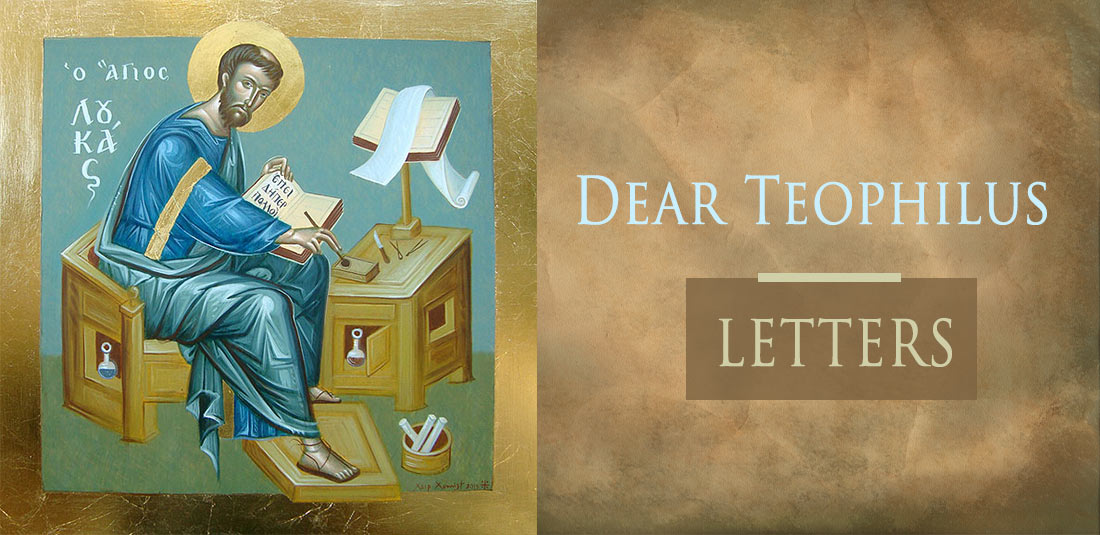
Dear Theophilus , (Letter 77. )
You pointed out that you saw a sign which said that Jesus saves and underneath it there was some graffiti asking: from what? Let’s consider this a little bit.
If we look to Christianity for rescue from earthly tribulations, then it is obviously a failure. Salvation is from that radical and tragic failure that is called the Fall. What the fall does, is bring death into the world of man, death which represents the separation of man from God. This death brings not only the biological end of man but also brings with it the concept of life as a meaningless waste, a sense, of what Augustine described as not a land of the living but of the dying.
Salvation means a restoration of the life that God intended for man and which we have no power to attain. We know that we were not created for this ephemeral life and we long, in our very depths for that which we refer to as Eternal Life. As the Apostle John writes, through Christ we became aware of this Life that is our inheritance. Interestingly, this Life did not appear as some philosophy, as some new teaching but it came to us in the form of a Person.
The unbeliever may shrug his shoulders in disbelief but the events of history testify to the reality of what this Person achieved. This Person did not write a single line, died an ignoble death on the cross, and yet, this Person has been at the center of world history for the last two thousand years. Christ is the saviour of the world and he accomplished this by giving us the possibility of entering into a new life, one which is eternal.
It is true that the world seems to be going on as before and yet, it is a totally different world. The world has been gifted with meaning and a purpose. There is no more separation and loneliness, there is not eternal darkness that descends with death. This is what our faith brings to us.
But at the same time, there is frustration with our faith and this frustration will last as long as we continue to see a faith whose main purpose is to help, to be of utilitarian importance. This is what religions are for and this is not the reason why Christ was incarnated. People have tried to console themselves with belief that death is natural, it is part of the process of nature, death is preferable to what old age can bring with it. And moreover, when man dies, he is freed from this vale of suffering and a part of him somehow survives. But keep in mind that neither the doctrine of the immortality of the soul, nor that of death as liberation, nor of death as punishment, are in fact Christian doctrines.
This consolation of ‘religion’ worked as long as a death-centered’ view of life held sway. But the world has changed, it has become more secular and with this change came the realization that old explanations are insufficient. Ironically, secularism has become an alternate effort at explaining death and man’s life. Modern man is tired of hearing that this world is meaningless and there is a better world awaiting post-death. Modern man is tired of hearing about survival of which no evidence is obvious. The modern view is that it is only this life that has meaning and we should make the most of it. Yes, life ends with death, and this is unpleasant, but death is a natural and universal phenomenon and we should not focus on it but focus on building a better world here.
For Christianity, the main goal is not help, but it is Truth, it is a revelation about Truth which gives meaning and coherence to life and death here in this world. The problem with secularism is not that it is not sufficiently helpful but that it is overly helpful and creates the illusion that man is in total control of his fate.
The gnawing sore that challenges secularism is the empirical realization that all is not well with the world and secularism has no explanation for the origin of this ‘fallenness’ of the world. Secularism ignores the fact that this world was given as a means for man to communicate and ‘unite’ with God and man failed in this. Man has become estranged from God in this life and this separation continues until salvation, through Christ, comes into history.
In this world, disease and illness and eventually, death, are ‘normal’ but in light of our faith they are seen as abnormal. Our sufferings reveal the failure of this ‘life’, of this world that we have transformed into a cosmic cemetery. We desperately want a defeat of suffering, but Christ does not offer a defeat but a transformation of this illness of ours into a victory. The only true, and lasting, and final healing is through God – all else is temporary and will fade away. Christ comes not to counteract our attempts at physical healing through medicine and science, but he comes to tell us, that there is no ultimate healing in all of this. It is always temporary with the spectre of death looming over the enterprise. Faith does not come only to heal us – it comes to make of us martyrs, which fundamentally means, witnesses. One of the most powerful gifts that Christ has brought man is that of meaning in all circumstances of life. Through his own suffering, Christ has given all suffering meaning and suffering has acquired the ability to be a sacrament, to be a sign of eventual victory, a sign that even dying has become a doorway for us to enter Life.
Of course, this is foolishness for the world. When one enters the Church for a memorial service, one is confronted with the corpse of him who was once a living, vibrant person and this seems so final, so irreversible, so ‘hopeless’. This person is being removed from the world of the living and all meaning seems to evaporate as we observe this body. This is where our faith steps in and we know, in a ‘transrational’ manner – called faith – that what we are witnesses to before this corpse is not the final story. Our basis for belief is not some doctrine, not some statement, not some argument but our connection and love to a Person who embodies and shares Life that death cannot touch. Christian faith is radically different in that it is not centered on some ‘religious belief’ but on love. As St. Paul wrote to the Corinthians, our knowledge is imperfect, and our prophecy is imperfect…they will pass away. Only love never ends and will stay with us into eternity. It is in this love, for and of, Christ that we have something that cannot be taken away from us, and we will have it forever and ever.
There is one additional point that I want to make. The Resurrection stands outside of the time that we are used to and therefore it is not open to be proven by the laws of our natural world. Notice that the disciples have difficulties identifying Christ when confronted with him but they do know him in a different sense because they feel their hearts are warmed in his presence. The preaching of the resurrection is foolishness in our world and many remain sceptical. Notice as well, that Christ sent his disciples not to preach about the resurrection, nor to speculate about our post-death status, but to talk about repentance and forgiveness and about the new kingdom.
In Christ, death itself has been transformed and has come to be the supreme entrance into a new and eternal life. It is up to each of us to make our individual deaths acts of communion with Life
There is much that we do not know and it is futile to speculate. We do not know all the details – the whens and hows – but we do know that the passover of all of creation has commenced, that even here and now we can partake of the joy of the Resurrection. We crave certitude and answers but we are asked to live in loving patience and trust. Many find it difficult to accept what I have written because that final and total answer is not given. Many turn away because they expect their pain and suffering to be magically removed – that biological death disappears – but it is not so, this is not the way things operate, for whatever reason. In chemistry, during a reaction, there is what is called the transition state as reactants are on the path to being transformed into the final products. This is a high energy state, which means that it is ‘uncomfortable’ and shows that the reaction has not been completed. We are in a similar situation – we are in a ‘transition state of cosmic proportions’ and it can be uncomfortable, but Christ, through his Resurrection has shown us what the final ‘products’ are of this amazing cosmic reaction that we are involved in. He has shown that there is indeed going to be a New Creation, the kingdom of God which already has its representative here in the Church.
Sincerely,
Bar-Abbas