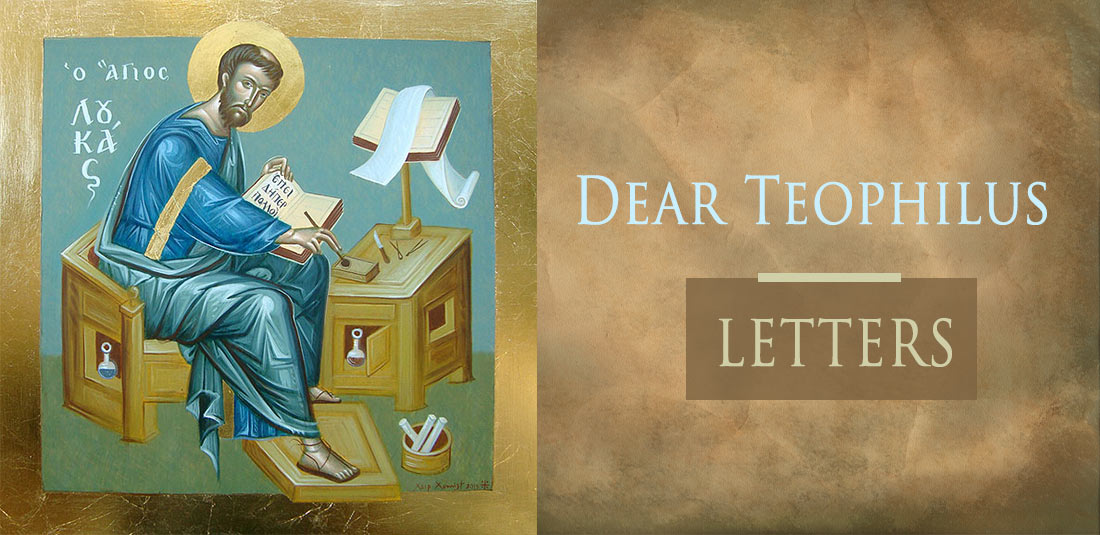
Dear Theophilus , (Letter 5. )
In our last letter, we left off with Jesus’ realization that his fate involved suffering and an imminent death. Why did Jesus have to die?
Wouldest thou love one who never died
For thee, or ever die for one who had not died for thee?
And if God dieth not for Man & giveth not himself
Eternally for Man, Man could not exist; for Man is Love
As God is Love; every kindness to another is a little Death
In the Divine Image, nor can Man exist but by Brotherhood.
(William Blake, Jerusalem)
This brief excerpt gives one reason for Christ’s death – to embody and show God’s love for man. It also shows the falsity of those who, for various reasons, find it difficult to call Jesus divine because it seems so preposterous to them. But if God is not involved in our redemption on Calvary then Jesus becomes even greater in stature than God (and of course, this is ridiculous). What kind of God would He be sending someone else to suffer on behalf of mankind? What kind of love would this exhibit? But there is also another reason why Christ had to die.
One of the goals of the Incarnation is to offer the forgiveness of sins to mankind. One way to consider sin is to see it as a transgression of a certain prohibition, to see it from a moralistic point of view. There is merit in this but it does not even come close to explaining how deep, injurious and widespread sin is. Another way to see sin is to see it as the incarnation of evil and as was stated earlier, Christ came to battle the one who is the source of evil – Satan.
The struggle that Jesus was involved in was not with Rome or with other worldly powers. He battles against spiritual entities that underlie all sin. What is the main weapon in the hands of Satan? It is the threat, and execution of death. Satan, through death, achieves two goals. He instills fear and he attacks the goodness and viability of creation. Christ was well aware that if we respond in kind to the spiritual entities we are struggling against, then we fall into Satan’s well-laid trap. In a sense we authenticate him and his actions. We cannot use violence to liberate ourselves from violence. Instead, when we resort to violence, to judging others, what we prove is the power of violence. So, what does Jesus do? He takes on death and does not respond in kind to it and thereby, he disarms Satan of Satan’s main, but not only, weapon – death. Jesus has to die so as to experience the most powerful weapon in the arsenal of Satan, take on the most that Satan can attack with, and in this manner defeat death with death.
But, in addition to this, somehow, in some mysterious manner, it is necessary to undertake suffering in order to attain a fundamental and revolutionary change in creation. Christ’s suffering becomes a weapon in his hands, a weapon to overcome and defeat the spiritual enemies that lie behind the malaise that afflicts creation. We are saved not only from suffering but also, inexplicably, mysteriously, through suffering. Suffering is also Satan’s weapon and by undergoing our suffering, with faith and hope, we further disarm the powers that lash out against all of creation.
In hindsight, it is very easy for us to see everything from the perspective of the Resurrection but, remember, Christ is fully human and being fully human he suffers from uncertainty as he faces the ignominious death on the cross. Much has been written about the words of Jesus from the cross: “My God, my God, why have you forsaken me.” Here we have the anguish and pain and suffering and uncertainty that Jesus, as a human, faced. The great Japanese writer Endo, who wrote a book called Silence says the following: “I did not write a book about the Silence of God; I wrote a book about the Voice of God speaking through suffering and silence.” Scorsese, commenting on the book Silence, says about God that He leaves much more to the ways of men than we realize, and that He is always present, even in His silence. There is a depth, a mysteriousness to this silence and it isn’t a simple black and white matter of God’s absence or presence. It is a mysterious and deep communication with God. And if we look a little more deeply, we will see a new light opening for us, a new certainty that is being subtly expressed through Christ’s utterance. The quote above comes from Psalm 22 and Jesus clearly knew this, he intentionally quoted from this psalm. The Eternal Word is being silenced on the cross but at the same time, Jesus tells his disciples that this is not the final word. The Eternal Word cannot be silenced by the creation which came into being through this Word. No further words will come from Jesus’ mouth but the Scriptures, which speak of him, and for him, continue with words of hope, of triumph and certainty of God’s support. Psalm 22 ends with certainty in God’s trustworthiness and in the strong hope that everything is in God’s hand: “And when I cried out to Him, He heard me.”(verse 25) The Romans silence Jesus, but they could not silence Scriptures which speak for Jesus and thus already intimate that the story is not finished, it has another important chapter which will be revealed in three days time.
And all of Jesus’ actions are vindicated by God through the Resurrection, the Resurrection which if not true, as St. Paul says, then Christians are the most pitiable of all people. The Resurrection was not an easy sell even in the first century AD. In one of Aeschylus’s plays Apollo says at the Areopagus: “When a man dies, and his blood is shed on the ground, there is no Resurrection.” Ironically, it was at this very spot, that we read in the Book of Acts, about Paul proclaiming the Resurrection. The Greeks thought that Paul was talking about a new god, but, when they realized what he is talking about – about a man coming back alive from the dead – they leave him. People even at that period in history were not gullible – they knew that dead men do not come back to life. One has only to read Celsus’ A Discourse Against the Christians to see that arguments against the Resurrection were already widespread in the second century AD.
Even today, it is very difficult to put our minds around the idea of the Resurrection because it is such a rare occurrence. The reason for this is that we cannot know the Resurrection using categories of the Old Creation. The Resurrection, in the sense of no return to death, happened only once and that is what causes us to be suspicious. It can’t be true. I think we need to keep in mind a statement made by Ludwig Wittgenstein, a Jewish philosopher teaching at Cambridge University: It is love that believes the Resurrection. To prove to someone that the Resurrection occurred is difficult because for every argument there will be a counterargument. The best evidence we can give of the reality of the Resurrection is through our lives of love and forgiveness because it is love and forgiveness which are the currency of this new world that is dawning through the Resurrection. To believe in the Resurrection requires that we commit ourselves to Christ and this will enable us to experience the reality of the Resurrection. You see, what the Resurrection does is open the door to a new reality and we cannot continue using the same criteria that we presently use. A totally new reality has made its appearance and we need to use a new set of rules in interacting with it. It is love that affirms and authenticates the other and it is love, as Wittgenstein pointed out, that enables us to see the depths of the world before us by realizing that the final fate that awaits creation is Resurrection.
Without the Resurrection, creation has no meaning and seems to be an exercise in futility. Those who espouse some kind of “spiritual” continuity of human souls whether in some heaven or some other realm fail to answer the following question. If the final goal is some kind of soul-survival, what is the point of the universe, of all of the creation? It is superfluous and meaningless, it is just an encumbrance that we need to get rid of. It is easy to succumb to the view that the soul (whatever that may be) is the most fundamental part of a human being, because when we look at what happens to matter – it decays and decomposes – how can we say that it has any lasting value? At heart, we are really anti-materialists who see no lasting value in materiality. But we have come to realize that the universe is much more complex and strange than we have imagined and we should not rule out matter as if it is of no value. But more about this in the next letter.
Sincerely,
Bar-Abbas