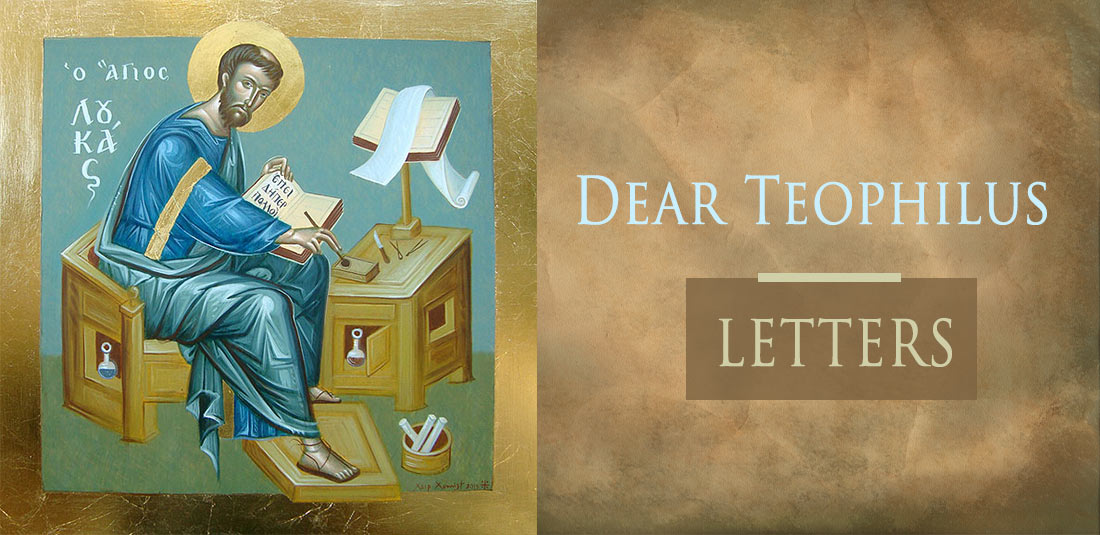
Dear Theophilus , (Letter 38. )
You have raised this question in the past and it is time to address it more fully – what is it that Christ has accomplished through his Incarnation, suffering and Resurrection? There have been several attempts at answering this question and it will repay us to consider them in some detail. But before we come to this, a little bit of background will hopefully fill in any spots that need clarification.
The God preached by Christianity loves His creation and will not abandon it. As Metropolitan Kallistos Ware says, God is all-powerful but He is, puzzlingly to us, also humble. This is one of the most startling and original ideas ever propounded and we will be using this as a background in trying to better understand what we mean when we talk about salvation.
Crucial to our discussion is the presence of death in creation. We have touched on this in the past but it is of such paramount importance that we will again look at death. There is a widespread view that death originated with God, a view that is common even amongst many Christians. In Genesis we read that the Lord God commanded man, saying, ‘Of every tree in the garden you may freely eat, but of the tree of the knowledge of good and evil you shall not eat, for in the day that you eat of it, you shall surely die.’ The implication here is that man was punished with death in violating the command given to him by God.
But a more reasonable interpretation of this exchange between God and man is to see God’s statement as simply spelling out the inevitable facts of creation. If man turns away from God, the only source of life in creation, the only possible outcome of that will be death. Notice that God does not say that He will kill Adam but that Adam will die. Adam’s fault was that he sought to find life in the world and only in the world as signified by the forbidden fruit. Man tried to live independently of God and in this he failed and death resulted.
A richer and deeper understanding of sin is to see it not only in juridical terms but to see that it represents the failure to realize love and communion with God and with others who have been created by God. In a sense, Adam committed spiritual and physical suicide.
Already, with St. Athanasius, we see that the issues involved in the Fall are not legal or juridical because St. Athanasius asks the question – which I am sure many others have asked: why didn’t God simply forgive Adam?
What is at the heart of the whole question of the Fall is not some legal transaction but a question of ontology, that is, a consideration of the very essence and substance of man. Irenaeus saw man’s path as a gradual attainment of the ontology of eternal life, to become like god, but Adam tried to short-circuit this and attain it quickly and he obviously failed. Let us now take a look at some dominant theories trying to explain the Atonement, the process whereby man is redeemed.
There is what is called the ransom theory which sees Jesus as being the ransom paid to satisfy the devil’s demands for the rules of justice to be maintained and through this ransom mankind is freed from dominion by the devil. This view held sway for approximately one thousand years.
In the eleventh century, Anselm challenged the theory of ransom by pointing out that the devil has no rights over man and God does not need to carry out any transactions with the devil. Anselm’s explanation became known as the debt or satisfaction theory. Man, by sinning has dishonored God and therefore, justice is demanded in the form of punishment for mankind. Only Christ can pay this debt for each of us and if we put our faith in Christ then we are forgiven. The problem with this theory is that God is constrained by what is referred to as divine justice and here we have ‘something’ which is even above God – some universal justice. This became the dominant theory in the West and it is reflected in the words of many hymns.
The Protestant Reformers developed what is called the penal substitutionary model of atonement. In this theory, justice still demands that man’s sins be punished but Christ has received this punishment in our stead and we no longer have to be punished.
All of this points out what an impact a judicial/legal concept of atonement has had and how much damage it has created in souls sensitive to the incomprehensibility of the master of the universe involved in a legal action against puny man. It is somehow incongruous to think of a God of love and a God of total wrath being present in the same being. This appears ludicrous to many non-Christians and has been the cause of loss of faith for a significant number of people.
Many now find Abelard’s position more acceptable and this has been espoused by many today. Abelard deemphasized the crucifixion and focused his attention on Christ’s love. For him, the primary purpose of Christ is to act as an example that humanity can follow and this became the chief position held by many within what has come to be referred to as the liberal wing of Christianity. But this position really does no justice to the depth of what had been accomplished by Christ. In fact, in this way of thinking, Christ could have been replaced by any ‘good’ person to act as an exemplar.
I have listed the options above because they are still circulating and many still subscribe to one or the other of them. The depth of Christianity’s understanding of the atonement is that its basis is not a court of law or jurisprudence. Its underlying cause is God’s love for man and for all of creation. You see, many proposals are so humanity-centred that they forget to take into account all of the rest of creation as if it were merely a backdrop with no connection to the atonement. The purpose of atonement (at-one-ment) is primarily therapeutic. The Greek word for salvation is soterias whose root meaning is healing. We are not just saved from something – damnation and suffering and death – but we are, and this is even more important, saved for something. In the liturgical services of the East, God is referred to as the Lover of Mankind showing that the creation of man is not a temporary phenomenon which ends and comes to a complete stop with death but will be an ongoing story beyond the limits of death.
You see, that if we place this cosmic drama we are participating in under the aegis of a courtroom drama, then this leads to a gross misunderstanding as to what the creation project is all about. Are we surprised that so many people have been turned away from the distorted image of a wrathful God whose good news is that some people are eternally damned. This is a true travesty of our faith and yet, many, even until today, still cling to this legal interpretation of redemption.
Christ comes and joins humanity and saves it from death, from sin, from evil powers that challenge God. He comes to give us union with that which is eternal – we become at one with God – and through this our very ontology, our substance is transformed so that it can now harbor eternal life. This is the good news that Christ has come to offer to mankind and it is indeed good news because it speaks loudly and clearly of God’s love for us.
But what of all that talk of judgement, of damnation and condemnation? Are these not also part of man’s destiny? Indeed they are, because man has free will, and this allows these dire possibilities to be actual for all of us. God does not turn away from us, even when we go against His will. In the felicitous phrase of St. Anthony the Great of Egypt, to say that God turns away from the wicked is like saying that the sun hides itself from the blind.
God realizes our failings and weaknesses through which we fall but God continues to love us. We, in our descent into sin, experience this love as judgement and pain. You see, it is we who are our worst judges and who condemn ourselves and it is not God who stands in judgement over us in a clearly unfair confrontation. How could we possibly think of standing up before the master of the universe as I stated above. We judge ourselves and find ourselves wanting.
Throughout our lives, as we forgive others and through this, ourselves, we slowly acclimatize our selves so that we can stand more and more light so that when we come before the dazzling light of God we will be prepared for it and will not need to turn away in pain from it. We are asleep in sin and think of our reaction when we are suddenly awakened with a strong beam of light shining into our ‘eyes’. How much pain that would cause, and throughout our lives, through forgiveness and repentance, we are slowly waking up and getting used to the light that will eventually confront us. Remember that the doors of hell are locked from the inside.
Sincerely,
Bar-Abbas.