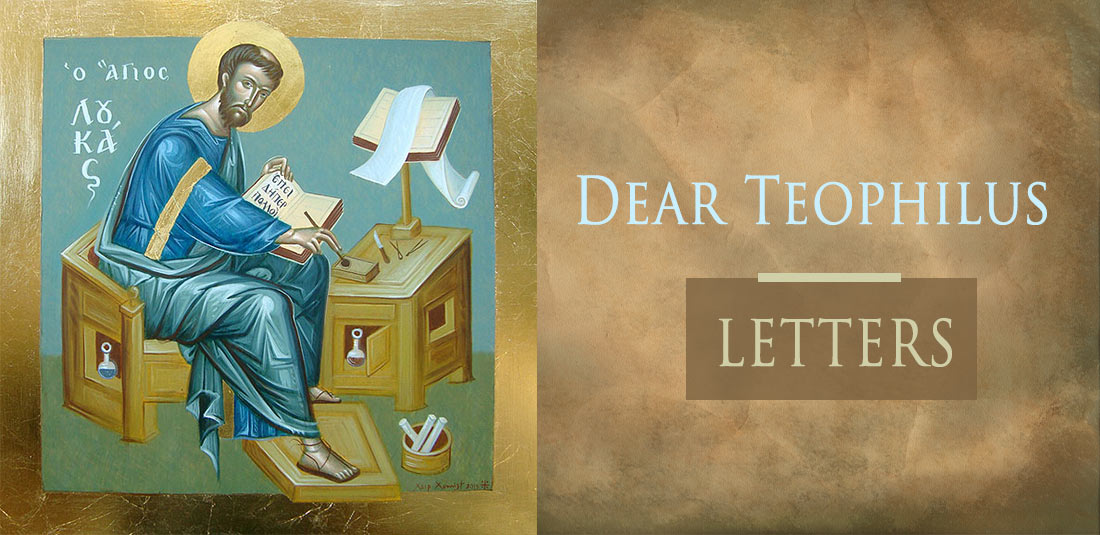
Dear Theophilus , (Letter 27. )
You raise some questions that I am sure others have thought about. Why do we read near the end in Matthew’s Gospel about people rising from their graves when we know that there are many corpses still lying in graves? Why does St. John Chrysostom, in his Easter homily say that the graves are empty when a simple verification by exhumation will give the lie to this statement? Why do we call Mary a virgin even after having given birth, which is biologically impossible?
What we see here are questions that many ask and what I will try to do is give a certain way of approaching them. What we have come to here are different ways of talking about truth. The other very important matter is that trying to describe reality completely through the use of words and logic is an impossible task – reality is just too complex to be completely described through words.
The objections mentioned above underlie much of the doubt that people feel about our faith. They think that it is a matter of unsubstantiated opinion or wishful thinking and that is why they often see it as contrary to science. They feel that much of what is said in the Church is simply words which do not have any bearing on or relationship whatsoever with reality. So, let’s take a look at some of the points raised above.
Matthew, and only Matthew, writes about the graves opening up in Jerusalem as a result of Christ’s death. What is important here, and we will see this in other instances, is to analyze what is being said. Is it a bald factual statement that graves opened up or is Matthew pointing us to another level of truth and the best way he can do this is by drawing an image of the dead arising from their graves?
In reading the Gospels, one is struck by the puzzlement that enveloped the apostles in trying to comprehend the strange occurrence that they witnessed in Christ’s death and Resurrection. You can almost sense them groping for words and ways to express the inexpressible. And it is not surprising that their witness betrays this incomprehension over the stupendous event of the Resurrection. Poetic expression, far from being an inferior way of interacting with and representing reality, is sometimes the most powerful means that we have of talking about creation. Often, in scriptures we see poetry being used as a means to express things which are very deep.
There are two broad categories that our faith uses to talk about our interactions with the world and with God. There is what is referred to as the cataphatic approach and the apophatic way of dealing with information. In the cataphatic, we have what is sometimes referred to as positive information which can talk about properties, characteristics, interactions. This is the method that is used in the sciences and this is the method thought by most people as the most powerful way of dealing with events and information. It is the default position for our talking about reality. But, there is a hidden danger in this approach in that it lulls us into thinking that our logical processes and language can grasp and describe reality completely and totally. We see this exaggerated importance of cataphatic dealing with nature in scientism which sees cataphatic statements as the only possible way of getting information about and dealing with the world, and this is exclusively through science. Everything else is of secondary importance and it is science which is the final arbiter of what is or is not real.
Apophaticism is a necessary antidote to this proud assessment of man’s intellectual capabilities. It points out that we are limited, as are all created beings, in our ability to grasp and portray the world. It is, however, important to underline the fact that apophaticism does not mean that we must abandon cataphatic approaches to knowledge. These are important with the proviso that we realize the limitations of this way of knowing. An apophatic way of speaking about God is extremely important because it underlines the fact that our language and logic is an incomplete way of talking about something that is unspeakable and cannot be bounded by words and logic.
So, by way of a preamble, let us get back to the question: what is Matthew trying to say when he says the graves were opened and the dead were walking on the streets of Jerusalem? What Matthew is trying to describe is fundamentally indescribable – what happened on the Sunday of the Resurrection – and he is groping for ways of passing this information on. In a sense, what he is trying to do is to cast some light on the significance of what happened in Jerusalem during those epochal three days. The essence of death had been changed but this is not something that you would visibly see. What this change is, is so stupendous that it literally boggles the mind. Death is no longer a terminus but a transition. It has truly, through Christ, become the Passover for all of humanity including the whole of creation. So, how to describe this in a language that would be accessible to everyone? Matthe does this through this image of the resurrection and of people walking on the streets of Jerusalem. The intention is not to give a ‘photographic’ expression but to talk about the significance of what has occurred. The very face and character of death has been transfigured. When John Chrysostom says that the graves are empty, he is not talking about an empirical fact. What he is saying is that here we have a fact that goes beyond what our senses tell us. He is talking again, about the fact that death is no longer a dead end for humanity. Death now opens possibilities for humanity which were closed until the coming of Christ and his sacrificial death. Biological death is no longer the overriding factor in human life because a new component has come into play.
The importance of the doctrine of Mary’s virginity lies not in an effort to refute biology but, again, to point out an important teaching that expressed in this way, is something that is graspable by people. Human nature is offered by Mary to God in order to make a human-divine meeting possible. If Jesus’s birth went through the same channels as any other birth, then this encounter between God and created humanity would still have been unattained. Mary shows absolute faith and trust in God and she, in doing this, is acting also on the part of all of humanity. She transforms the natural energy of motherhood from a biological function into a personal event of free consent and obedience. She undoes what Eve had done. She chooses and in this choice, she exercises her freedom from natural necessity and this is expressed in the doctrine of virginal birth. In Mary, the natural limits that have been placed on humanity have been defeated and this is the significance of the teaching about Mary being a virgin even after giving birth to Christ. In this whole event of the Incarnation we witness the transcendence of limits: the uncontainable is contained, he who is before all ages is an infant and much, much more is said. Mary represents the actualization of the purpose of creation – the fullest union possible between man and God, the fullest realization of life. But, I must point out that in no way does Mary take equal place with Christ as some have claimed when Mary is honoured. Her function is different from that of Christ through whom death is truly defeated.
The examples that we have discussed – and there are many others – point out the limitations of our rational grasp of this very complex reality that confronts us. The Church deals with this by positing what is called apophatic knowledge which underlines the limitations of relying exclusively on rationality and logic. We must constantly struggle against limiting reality to what our rational thinking can encompass. In an interesting statement Einstein states that the most incomprehensible thing about the universe is that it is comprehensible but this comprehensibility has its limits especially when we try to use our common language to talk about events in the New Creation. The examples we have touched on above are those that deal with the irruption of this new reality into our world. Even within science, quantum mechanics, for example, stretches out common sense grasp of the universe and challenges us by paradoxes such as the wave particle duality of light, a concept which runs counter to what we normally think. Reason offers us shallow – albeit important – truths about the mechanics of the universe but reason cannot really address the really important questions as to the meaning and our place in the universe. In the parlance of philosophy, reason is necessary but it is not sufficient – that is, reason cannot give us final answers to important questions but, at the same time, we must not succumb to irrationality. Apophatic knowledge does not glorify ignorance but cautions us about the ‘gluttony’ (and our deep thirst for certainty is a form of gluttony) that we crave through absolute knowledge which promises us control and leads to pride. Apophaticism calls us to humility with respect to our knowledge and calls on us not to judge since we do not have absolute knowledge of anything. Apophaticism resonates with what the poet Muriel Rukeyser wrote: the universe is made of stories, not of atoms. There is an important message for all of us in this statement.
Sincerely,
Bar-Abbas