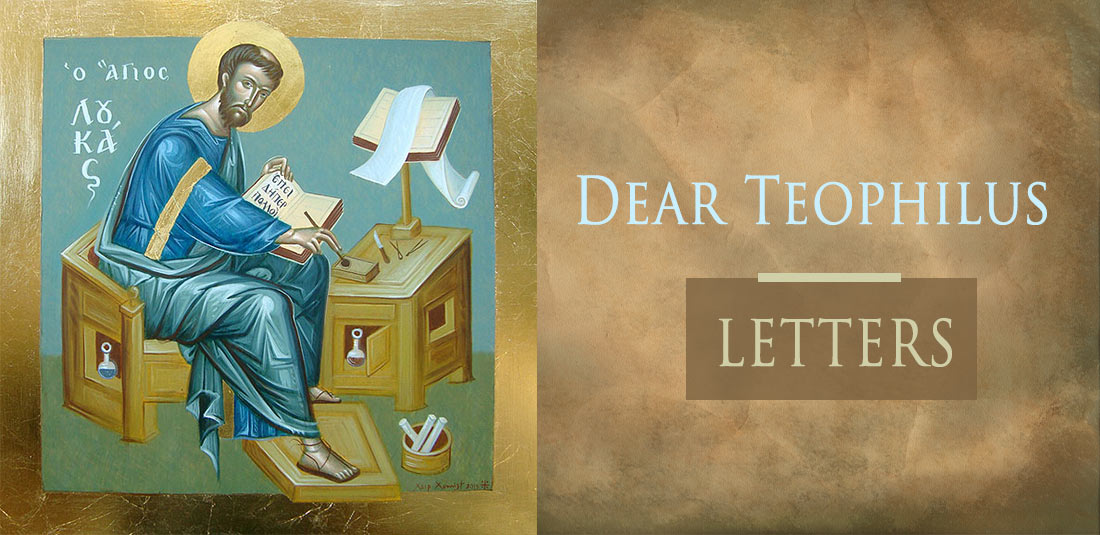
Dear Theophilus , (Letter 75. )
You seem to have only one thought on your mind. It is fine to talk about all kinds of achievements written in the Gospels and spiritual writings but, really, what has changed. The world goes on with its atrocities, injustice and death stalks everyone. So, what has changed, what has been achieved?
You are not alone in your thoughts because even the ancient world thought that the apostles talking about the resurrection of the dead was an absurdity. The immortality of the soul was a little more palatable but to speak about the resurrection was nonsense.
I think the main problem here is the wrong understanding of what is meant by the term ‘body’. It is perfectly obvious that our bodies are impermanent and change with time and become ill and die. But what we must ask is – what is the importance of the body to us and when we ponder this question we come to some interesting thoughts and ideas.
The role of the body in our lives is to enable us to have communion with the world around us and with our neighbors. We are not isolated ‘I’s’ living separate from the rest of the world but through our bodies we interact and this interaction reaches the highest level in what we call love. The body is therefore not an encumbrance on the soul but it enables the soul to have communion with creation. When there is a bodily death, then that is a tragedy because the soul is cut off from interaction. As it says in the Old Testament, there is no praise for God in Hades.
Therefore, when our faith talks about the Resurrection of the body what is meant is not a reviving of the sinews and muscles and bones of the body that we know and nourish because this body consists of only impersonal atoms and molecules. So when someone asks about the Resurrection body with the jibe where will those previous molecules come from because they have gone on to form other physical bodies, the question is nonsensical and obviously has no rational answer. St. Paul wrote in the first letter to the Corinthians to the effect that blood and flesh cannot inherit the Kingdom.
It is through our physical bodies that we love others, show kindness and forbearance. And as we are doing this we are not merely building up our stock of achievements and credits – we are in the process of building something else, something that will open up eternity for us to enjoy and share. We are building up our spiritual bodies and these will be resurrected and allow us to interact with others. Matter is not eternal but it becomes so when it is spiritualized. The world itself becomes something that has gone from the corruptible to the uncorruptable – it also has become spiritualized in the sense that it has not become less real but something that is now more real since it cannot suffer decomposition and death. We will experience resurrection to a new and fuller life. This became available through Christ’s Resurrection and this is why we celebrate it with such joy. Death – as a total and final separation from the world, those whom we love, and from God – indeed is swallowed up in victory and is no more. Its very substance has been transformed and although our physical bodies may suffer disease and death the story does not end there.
I am not saying that the physical body is unimportant and it is only the spiritual that is of value in us. The physical, the material is extremely important – hence the sacraments – because it is through this materiality that we form and give birth to our lasting body, the spiritualized body – not in the sense of something less real – but in the sense of something that cannot be touched by the ravages of time or disease or death.
We now come into a different form of existence and this is communion. Our being is defined through our relationships, through the love that we express to God and to our neighbor. We have this already in the Church. It is the Church that fosters our new being in the love that we can and do express. It is through the sacraments of the Church that you come into a new and lasting, imperishable existence.
When you ask since the coming of Christ, why isn’t everything different, why is the world going on as before as if no change has entered and you back your statement with – we still get sick and we still die. You are asking a wrong question because you are focusing totally on the matter that makes up your body and what happens to that body. But this matter has no life in it; it is temporary and finally, it is totally impersonal. Whether certain carbon atoms are in your body or are transferred to someone else’s body they do not carry any identity and therefore cannot be the basis for forming who a person is. They can be used by you – in the carbon in the bread that you give to a hungry man – but this is their main function. This matter enables you and empowers you to love your neighbor and it is in this love that a new and permanent you is being formed. In a sense, the body is the soul as love.
One of the striking pictures of the change that has occurred in the world and in men’s hearts is described in the Book of Acts. There is Stephen being stoned by an angry mob and as he dies he calls on God to forgive them. And close at hand, in fact holding Stephen’s cloak, is he who condones what is going on. He still abides by the rules of the old nature and yet, within a short while, he too enters into the Resurrection Life and becomes a follower of Christ and he too joins Stephen in a martyr’s death. Here is an illustration of the love that has entered the world, a love that comes from a different world, a love that changes the world in a profound and permanent manner. The name of the man who undergoes this transformation is, of course, Saul, who became Paul. He comes to realize that for a Christian death is birth into eternal life. This day becomes dies natalis, the birthday marking the date of the passing of a faithful believer.
Love is a unitive force, strikingly shown between Stephen and his tormentor. Love was Stephen’s weapon through which he conquered Saul, his oppressor. (Interestingly, Stephanos means crown in Greek). Stephen’s love for God enabled him to win over his persecutor on earth as his companion in heaven. This surely is the true life, a life in which the persecutor feels no shame because of forgiveness and the victim delights in the redemption of the persecutor because loves fills them both with joy which is the result of the Resurrection. As St. Fulgentius writes: My brothers, Christ made love the stairway that would enable all Christians to climb to heaven. Hold fast to it, therefore, in all sincerity, give one another practical proof of it, and by your progress in it, make your ascent.
And this joy is incarnated and commences with the physical body. Without the body we would not be able to express love, or live in it. It is true that in this fallen world we also suffer on account of our bodies. But through the Resurrection, we know that we are being gifted with spiritual bodies through which we will still be able to love. Love is so important because it does not allow us to forget the importance of the material and to slide back into some facile ‘spirituality’ which condemns the material as useless and in fact harmful. The Church’s respect for matter is expressed in the centrality of sacraments in the life of the Church through which man is slowly transfigured.
You lament the fact that there is no incontrovertible proof of the Resurrection occurring. Why can’t God just give us the needed evidence and then everything would be settled. But the important thing to remember is that the Resurrection, the post-grave existence, is all outside the domain of the natural. It points to something that cannot be addressed by our natural studies and investigations. In fact, as I have stated before, if we could generate the kind of proof that you yearn for, then we will have done a disservice. We would have shown that indeed nothing has changed and we have simply gained knowledge of a new aspect of the world that we know. We would not have introduced anything really new into our view of reality.
I want to remind you that truth is rarely just one voice. It is more like a symphonic ensemble that requires many inputs in order to create a deeper sense of the depth and nuance of reality. Truth in other words is symphonic in nature and not a solo performance as you imply in your pre-occupation with science.
Sincerely,
Bar-Abbas